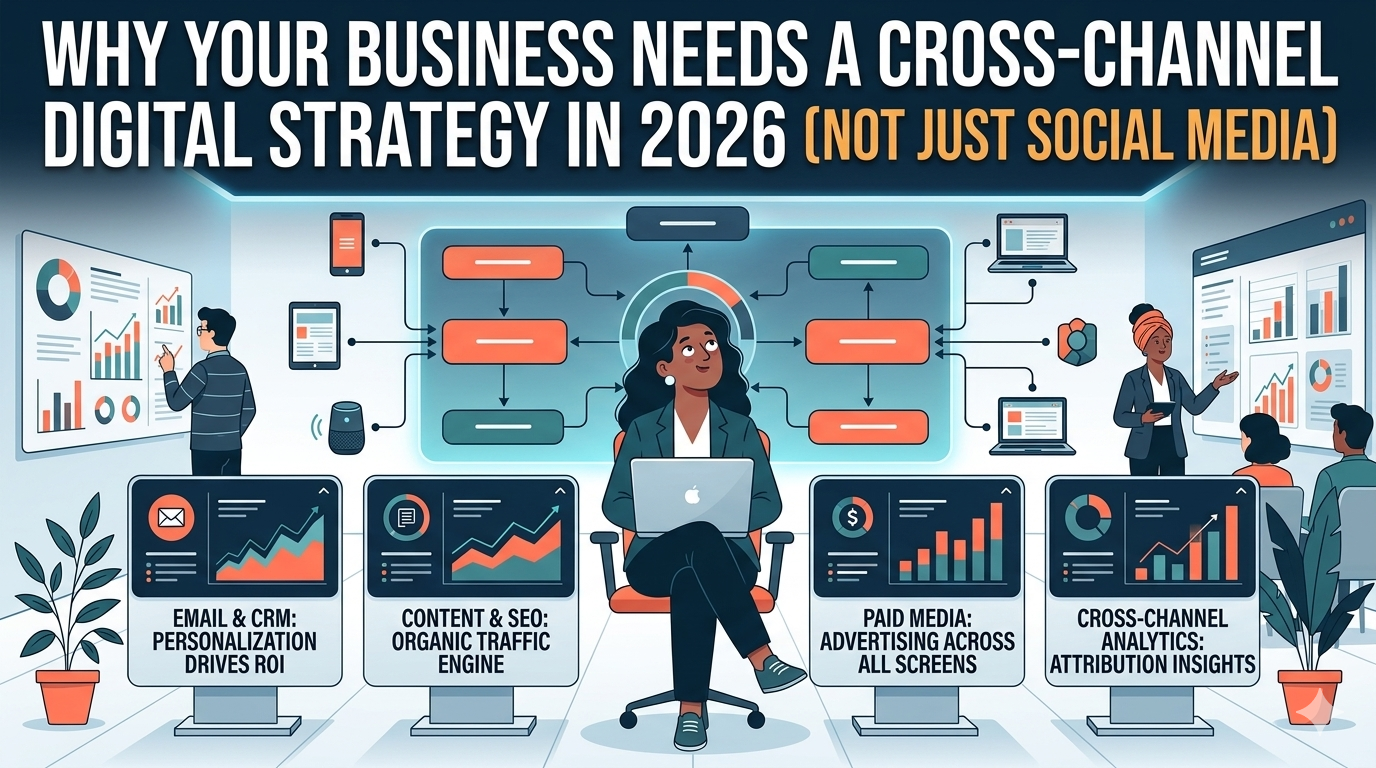
In 2026, relying solely on social media for your marketing efforts is like trying to win a marathon with only one leg. Customers interact across dozens of touchpoints before making a purchase, and they expect seamless, personalized experiences everywhere. A fragmented approach wastes budget and misses opportunities, while a well-executed cross-channel digital strategy drives higher engagement, better retention, and stronger ROI.
If you’re a business owner or decision-maker seeking reliable Digital Marketing services, understanding cross-channel strategies is essential. The best digital marketer or agency doesn’t just post on Instagram—they orchestrate connected experiences across search, email, content, paid ads, and emerging channels like AI search and connected TV. This comprehensive guide explains why this matters in 2026 and how to implement it.
What Exactly Is a Cross-Channel Digital Strategy?
A cross-channel (or omnichannel) digital strategy coordinates marketing efforts across multiple platforms so the customer journey feels unified and intentional. Unlike multichannel marketing, where channels operate independently, cross-channel marketing uses shared data, consistent messaging, and synchronized timing for a cohesive experience.
For example, a user might discover your brand via short-form video on social media, research on Google or AI-powered search, receive a personalized email nurture sequence, and complete the purchase through a seamless website or app experience. Every step reinforces the previous one, building trust and reducing friction.
In 2026, with AI agents, voice search, and ambient devices gaining traction, this integration becomes non-negotiable. Customers no longer think in “channels”—they expect your brand to be present and helpful wherever they are.
Why Is Social Media Alone No Longer Enough in 2026?
Social media remains powerful for awareness and community building, but platform algorithms are increasingly unpredictable, attention spans are short, and privacy changes limit targeting. Relying on it exclusively leaves you vulnerable to reach limitations, ad fatigue, and incomplete customer data.
Research shows customers now engage with nearly 11 touchpoints before purchasing, up significantly from previous years. Brands using three or more channels see dramatically higher purchase rates—up to 287% in some studies—compared to single-channel efforts.
Social-only strategies also struggle with attribution and long-term loyalty. Without supporting channels like email (which offers high ROI and owned audiences) or SEO (for sustainable visibility), you’re renting attention instead of building assets. In 2026, with the rise of AI search optimization and first-party data strategies, businesses need owned channels and integrated data flows to stay competitive.
The best digital marketer recognizes this shift and builds strategies that reduce dependency on any single platform while maximizing overall performance.
How Does a Cross-Channel Approach Deliver Superior ROI?
Numbers don’t lie. Cross-channel and omnichannel strategies consistently outperform single-channel ones:
- Higher retention and lifetime value: Strong omnichannel approaches deliver retention rates up to 89% versus 33% for weaker strategies. Omnichannel customers often show 30% higher lifetime value.
- Better conversion and revenue: Multi-channel campaigns can achieve 40% higher response rates and significantly lower cost-per-lead. Brands with robust strategies report 9.5% annual revenue growth versus 3.4% for others.
- Improved efficiency: Unified analytics and AI orchestration let you optimize spend across channels, avoid duplication, and personalize at scale.
A cross-channel strategy also supports privacy-first marketing. By focusing on first-party data collected ethically across touchpoints, you build trust while complying with regulations—something scattered social campaigns struggle to achieve.
Professional Digital Marketing services providers excel here by implementing proper attribution models, customer data platforms (CDPs), and AI tools that connect the dots.
Which Key Channels Should You Integrate in 2026?
An effective strategy blends these core channels:
SEO and AI Search Optimization: With AI summaries and generative engines changing discovery, optimize for intent, E-E-A-T (Experience, Expertise, Authoritativeness, Trustworthiness), and structured data. Visibility here drives qualified traffic long-term.
Email and SMS Marketing: Still among the highest-ROI channels. Use AI for hyper-personalization and automation to nurture leads and drive repeat purchases.
Paid Advertising (Search, Social, Display, CTV): Coordinated campaigns across platforms extend reach and retarget effectively.
Content Marketing and Owned Channels: Blogs, videos, podcasts, and community platforms build authority and provide fuel for all other channels.
Social Commerce and Influencer Partnerships: Combine discovery with purchase, especially on platforms favoring short-form video and authentic creator content.
Website/App Experience and Analytics: Your digital home base must deliver personalized, frictionless journeys with seamless transitions from other channels.
The best digital marketer will audit your business, identify high-impact channel mixes, and create a unified calendar and tech stack.
How Can You Successfully Implement a Cross-Channel Digital Strategy?
Implementation requires planning, technology, and expertise:
- Map the Customer Journey: Identify all touchpoints and pain points using data and analytics.
- Unify Your Data: Invest in tools that create a single customer view (CDP, CRM integration).
- Develop Consistent Messaging: Create core brand narratives adaptable to each channel’s format and context.
- Leverage AI and Automation: For personalization, predictive analytics, content optimization, and cross-channel orchestration.
- Test, Measure, and Iterate: Use holistic KPIs like customer lifetime value, attribution across channels, and engagement quality—not just vanity metrics.
- Ensure Privacy Compliance: Build trust with transparent data practices.
Most businesses benefit from partnering with experienced Digital Marketing services providers who bring proven frameworks, tools, and talent without the overhead of building an in-house team.
What Common Mistakes Should You Avoid?
- Treating channels in silos with separate teams and budgets.
- Ignoring mobile-first and voice/conversational interfaces.
- Over-relying on third-party data instead of building first-party assets.
- Neglecting measurement and attribution.
- Inconsistent branding or experiences that frustrate users.
Avoiding these pitfalls separates average performers from market leaders.
Real-World Impact: Why Partner with the Best Digital Marketer?
Businesses working with top agencies see coordinated campaigns that deliver measurable growth. Whether it’s boosting e-commerce conversions through synchronized social, email, and retargeting or driving B2B leads via LinkedIn, content, and SEO, expert guidance accelerates results.
The best digital marketer combines creativity with data science, stays ahead of trends like ambient experiences and machine customers, and focuses on sustainable, ethical growth.
Ready to Future-Proof Your Marketing in 2026?
A cross-channel digital strategy is no longer a nice-to-have—it’s the foundation for resilient, scalable growth. By moving beyond social media alone, you create meaningful connections, maximize every marketing dollar, and position your business for success amid rapid technological change.
If you’re looking for expert Digital Marketing services to design and execute a tailored cross-channel strategy, partner with professionals who understand the nuances of 2026’s landscape. The right team will help you integrate channels intelligently, leverage AI responsibly, and deliver experiences customers love.
Don’t let your competitors own the full customer journey. Start building your integrated strategy today and watch engagement, loyalty, and revenue compound.